Riddles of the Sphinx
Great Britain | 1977 | 92 minutes | Color | DVD | Order No. 00656
SYNOPSIS
PRESS
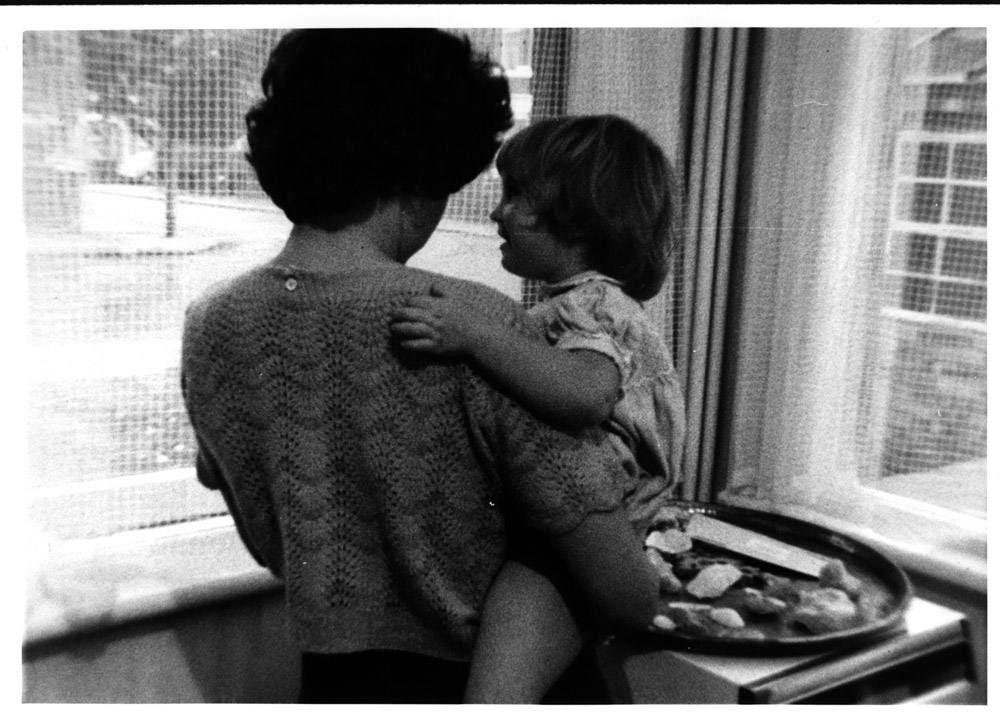
"Initially the soundtrack is devoted to her rhyming, circular stream of consciousness; only as her husband announces that he is leaving her does it break into synch-sound. Throughout, Louise's oblique progress with motherhood is depicted in a series of thirteen 360-degree panning shots. The effect is to rotate the boundaries of her world in a slow delirium. As its title suggests, 'Riddles of the Sphinx' is meant to raise questions. To that end, it succeeds admirably."
". . . the film can be grasped from a number of different angles, and each one delivers its quota of interest and pleasure to the spectator. Such openness is a precious quality in the cinema, whether commercial or avant-garde, in both of which coercive strategies have often reigned supreme. To find a film which crosses the frontiers of different audience expectations, which is unassuming and yet rigorous in its intellectual stance, and pleasurable and provocative at the same time, is rare indeed."
SCREENING HIGHLIGHTS AND AWARDS
- International House, Philadelphia
- Women Make Waves Film and Video Festival
ABOUT FILMMAKER(S)
Laura Mulvey (born 1941 in Oxford) is Professor of Film and Media Studies at Birkbeck College, University of London. She was Director of Birkbeck Institute for the Moving Image (BIMI) from 2012 to 2015. She is the author of Visual and Other Pleasures (1989); Citizen Kane (1992); Fetishism and Curiosity (1996); Death 24x a Second: Stillness and the Moving Image (2006); and Afterimages: On Cinema, Women and Changing Times (2019). She has co-edited British Experimental Television (2007); Feminisms (2015); and Other Cinemas: Politics, Culture and British Experimental Film in the 1970s (2017). Mulvey made six films in collaboration with Peter Wollen, including Riddles of the Sphinx (1977), and two films with artist and filmmaker Mark Lewis.
Mulvey is best known for her essay, "Visual Pleasure and Narrative Cinema", written in 1973 and published in 1975 in the influential British film theory journal Screen. (It also appears in a collection of her essays entitled "Visual and Other Pleasures" and numerous other anthologies.) This article was one of the first major essays that helped shift the orientation of film theory towards a psychoanalytic framework, influenced by the theories of Sigmund Freud and Jacques Lacan. Prior to Mulvey, film theorists such as Jean-Louis Baudry and Christian Metz attempted to use psychoanalytic ideas in their theoretical accounts of the cinema, but Mulvey's contribution was to inaugurate the intersection of film theory, psychoanalysis, and feminism. (2020)
Peter Wollen (born 1938 in London, died 2019) was a radical filmmaker, film theorist, and screenwriter, whose crucial book, Signs and Meaning in the Cinema (1969), continues to challenge and provoke. His other books include: Readings and Writings: Semiotic Counter-Strategies (1982), the alternative history of 20th century art Raiding the Icebox (1993), Paris/Hollywood: Writings on Film (2002), and Paris/Manhattan: Writings on Art (2004), all published by Verso, as well as a BFI Classic on Singin’ in the Rain (1992). He taught film at a number of universities and was Professor Emeritus at the University of California, Los Angeles. Wollen co-wrote the screenplay for Michelangelo Antonioni’s The Passenger (1975) and subsequently worked outside mainstream cinema, collaborating on six films with Laura Mulvey. His final feature film was a solo project, Friendship's Death (1987) starring Tilda Swinton as an alien who lands in Amman, Jordan, during Black September, 1970. His expansive interests included organizing paradigm-shifting art exhibitions, such as Frida Kahlo and Tina Modotti (with Laura Mulvey, 1982) and On the Passage of a Few People Through a Rather Brief Moment in Time: The Situationist International (with Mark Francis, 1989). (2020)
Subject Areas
RELATED LINKS