
Peter Valentine, diagnosed schizophrenic and unmedicated all his life, fought MIT while they demolished his neighborhood to create a new development- University Park. After 7 years in court with MIT, they gifted Peter the apartment building he lived in, moving it to another street.
SYNOPSIS
This is a film about gentrification, rent control, mental illness, unconventional healing strategies, and extractive practices of university expansion and development- told through the lens of the unconventional life story of my uncle Peter Valentine. Diagnosed from an early age as paranoid schizophrenic but choosing to live his life unmedicated, Peter lived independently, riding the edge between mental illness and magic as an eccentric, beloved, and respected local legend of the city of Cambridge.
The film follows Peter’s unusual journey, weaving around the extraordinary events surrounding his life, his family, his house, MIT, and the city of Cambridge. Utilizing a combination of traditional documentary approaches, performance art interventions in gentrified spaces, and virtually created manifestations of Peters’ inner world, the film immerses the viewer in Peter’s cosmology.
Peter was an outsider who lived in an incredibly non-traditional way and his relationship to neurodiversity was unique. He gained community support and created a system of protection around himself based on his relationships with where he lived. His brother Lee, my other uncle, committed suicide at age 30 when he was living in my house- I was four years old. After Lee's death, Peter was estranged from the family for 30 years.
After Lee's death, Peter was not the owner of his rent controlled three-story house. It was divided into apartments, and he rented one of them, living on disability payments. When MIT wanted to demolish his neighborhood to develop University Park, Peter refused to move, insisting that his apartment was his laboratory for research on Electromagnetic Arts, a psychic defense system he’d created, developed, and taught. In 1991, after seven years of Peter’s insistence and many legal hearings, MIT physically moved Peter’s building 900 ft to another plot of land in Central Square. They also sold the entire house to Peter for a dollar. The rest of the neighborhood was demolished, and MIT moved forward with their development of University Park.
The film documents Peter’s refusal to leave his house, and how it was joined with a longstanding local movement around rent control and tenants’ rights. What Peter did not know when he moved into his apartment was that his building and the buildings surrounding it had been at the center of the tenants’ rights movement in Cambridge for over a decade, a focal point for conflict between the landlord and urban development practices of MIT and the housing needs of Cambridge.
As we move through the film's universe, we meet participants such as my mother Adi Bemak, longtime activist and therapist, who was responsible from an early age for the emotional care of her two mentally ill brothers, Phil Barber, an old friend of Peters and housing activist, who during the time of the University Park development regularly climbed into dumpsters to search for classified documents on the University Park project and share them with the housing rights community, and Steve Fernandez, who was an MIT student at the time of the development, and was violently beaten and hospitalized by the MIT police during a raid on Tent City, a month-long encampment mobilization led by unhoused people and allies.
We also meet Peter himself, who wears colorful handmade clothes, strongly believes in the ability of Electromagnetic Arts to heal oneself as well as the city of Cambridge as well as the world, and often attends City Council meetings to speak on issues such as immigration, bettering Cambridge, gay marriage, and the greed of housing developers. Peter’s house is well-known landmark in the city and is surrounded by a purple fence decorated with brightly painted poetic and profound phrases. “We’re all electricity. And the art of life is how we use our electricity. Our words are electrical.” Peter says energetically with a playful spark in his eyes. He is dressed in a neon pink homemade felt jacket with huge green rhinestone buttons and sitting on a plastic chair in the audience of a meeting of the Cambridge Historical Society. “And I believe that if we use our words electrically…electrically means that when they bump against each other they sparkle. And the more healthily electrical things are, the stronger a civilization is and the longer it will last.” In this archival footage, the camera cuts to the panel of men in grey suits sitting at one long table in the front of the room. The men nod solemnly, listening intently- Peter has made a point.
ABOUT FILMMAKER(S)
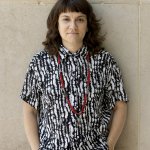 Amber Bemak
Amber Bemak is a filmmaker, artist, and educator. In support of her in-production film Cosmic Moose and Grizzly Bears Ville (release date early 2028), she has received a 2023 Guggenheim Fellowship, a 2025 Creative Capital Award, a 2025 LEF postproduction grant, a 2025 Yaddo artist residency, and a 2026 Millay Arts Residency, among other awards.
Bemak's work has been seen at venues including the Carnegie Museum of Art, the National Gallery of Art, the Dallas Museum of Art, the Modern Art Museum of Fort Worth, and the Tamayo Museum. Festivals include Oberhausen, Doclisboa, BAM cinemafest, BFI London, Ann Arbor, International Short Film Festival Hamburg, Onion City Experimental Film Festival, Kassel Dokfest, Ann Arbor Film Festival, Morelia, and Prismatic Ground.
Bemak has taught film theory and practice in India, Nepal, Kenya, Mexico, and the United States. She is an Associate Professor of Film and Media Studies with Hunter College.
RELATED LINKS
PROMOTE THIS PROJECT
Put a donation widget on your site. Click here for code.
ABOUT YOUR DONATION
Women Make Movies (WMM), Inc. is a 501(c)(3) non-profit media arts organization registered with the New York Charities Bureau of New York State and accepts charitable donations on behalf of this project. Your donation will be spent by the filmmaker(s) toward the production and completion of this media project. No services or goods are provided by Women Make Movies, the filmmaker(s) or anyone else associated with this project in exchange for your charitable donation.
Your contributions are tax deductible to the fullest extent of the law, and a confirmation of your donation will be sent via email. WMM will send you an acknowledgement letter in the mail to the address listed for tax purposes.
